
Gutters have one job: move rainwater off your roof and away from your home. When they are too small, hung wrong, or drain in the wrong spot, that water ends up near your foundation, in your flower beds, or behind your fascia boards. Good gutter installation in Woodstock, GA, takes the right size, the right slope, and a clear path for water to leave. Rise Residential Roofing serves homes across Cherokee County, including gutter installation in Canton, GA, and the same rules apply in both towns.
This guide explains each part of the job in plain words, so you know what to ask for and what to expect. Have a question about your home? Call Rise Residential Roofing at 678-772-6995.
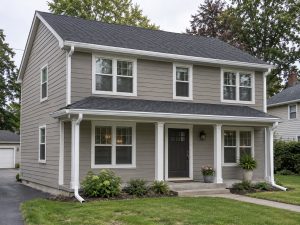
Why Woodstock Homes Need the Right Gutters
Summer storms in Woodstock can drop a lot of water in a short time. Many yards here also sit on red clay soil, which can drain slowly. When gutters fail, water can pool near the foundation, contribute to a damp crawl space, and wash away soil.
Tall pine and oak trees are common in local neighborhoods, too. Needles and leaves add weight and can slow water flow. That is why the way your gutter system is sized and hung matters so much here.
Gutter Sizing: How Big Should Your Gutters Be?
Two common options for homes are:
- 5-inch K-style gutters: A common choice for single-family homes with average-sized roof sections.
- 6-inch K-style gutters: A higher-capacity option for larger or steeper roof sections that send more water into a gutter run.
To pick the right size, an installer looks at three things:
- The roof area that drains into each gutter run
- The roof pitch
- Local rainfall intensity, especially during heavy storms
A home with steep, wide roof faces may benefit from 6-inch gutters. What matters is how much water each run receives and how quickly the downspouts can carry it away.
Gutter Slope: Getting the Water to Flow
A gutter needs a slight tilt toward the downspout so water does not sit still. About 1/4 inch of drop for every 10 feet of gutter is a starting point, though the slope can vary with the system and the outlet locations.
Too little slope leaves standing water, which can attract mosquitoes and add weight to the gutter. Too much slope can make the gutter line look uneven from the street. On long runs, an installer may slope the gutter down from the middle toward a downspout at each end.
Attachment: How Gutters Stay on Your Home
How a gutter is fastened has a big effect on how long it lasts. Two common methods are:
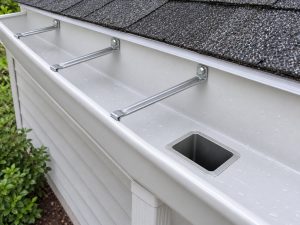
- Hidden hangers: These sit inside the gutter and are fastened through the back into sound support. They are a common choice for new installations because the hardware stays out of view.
- Spike and ferrule: This older method uses a long spike and a sleeve across the gutter. Spikes can loosen over time and allow the gutter to pull away from the house.
Hanger spacing and fastener placement depend on the gutter system and what supports it. The gutter should sit under the drip edge, the metal strip at the roof’s edge, so water drops into the gutter instead of behind it. If the fascia boards are soft or rotted, they need attention before new gutters are attached.
Outlets and Downspouts: Where the Water Leaves
The outlet is the opening in the bottom of the gutter that connects to the downspout. A good plan considers:
- Downspout count: About one downspout per 30 to 40 feet of gutter can be a starting point. Long runs or roof sections that collect more water may need additional outlets.
- Downspout size: A 3-by-4-inch downspout can carry more water than a 2-by-3-inch downspout and may suit a higher-volume gutter run.
- Outlet placement: Outlets belong at the low points, where the gutter slope sends the water.
Even a well-sized gutter can overflow if water cannot get out fast enough.
Drainage Routing: Moving Water Away From Your Foundation
Getting water off the roof is only half the job. It also needs a place to go where it won’t pool next to the house or flow back toward the foundation. Downspout extensions, splash blocks, and underground drain lines are common options. The right setup depends on the slope of the yard and where the water can discharge.
With Woodstock’s clay soil and sloped lots, it helps to check where water naturally flows before picking downspout spots. Leaves and pine needles can still slow things down, even with a good layout. You can learn more about options in our guide on gutter guard installation in Canton, GA.
Installation and Repair vs. Gutter Cleaning
Gutter installation involves sizing the system and setting the slope, hangers, outlets, and downspouts. Replacing an existing system also means removing the old gutters and checking the fascia before attaching new ones. Repair work can cover re-hanging sagging sections, sealing leaky seams, and replacing bent pieces. See our gutter repairs in Canton, GA, page for more on repair work.
Rise Residential Roofing does not offer routine gutter cleaning, such as scooping out leaves or flushing downspouts. If a gutter still overflows after it has been cleared, the slope, outlet placement, or downspout capacity may be part of the problem.
Get the Right Gutters for Your Woodstock Home
Roof size, fascia condition, and where water flows across your yard all affect the gutter layout. For gutter installation in Woodstock, GA, call Rise Residential Roofing at 678-772-6995 or contact us to set up an estimate.
Frequently Asked Questions
How much does gutter installation cost in Woodstock, GA?
Cost depends on the size of your home, the gutter size, the material, and the number of downspouts. Aluminum is a common material. Call us to get a price for your home.
Are 5-inch or 6-inch gutters better for my home?
Five-inch gutters work for many homes. Six-inch gutters can be a better fit for large or steep roof sections. If your gutters already overflow, check the outlets and downspouts too, since gutter size may not be the cause.
How long does gutter installation take?
A straightforward installation may take a day. Larger homes, difficult access, or fascia repairs can add time.
How far should downspouts drain from my house?
Direct the water several feet away from the foundation to a spot that slopes away from the house. If water still pools or runs back toward the foundation, a longer extension or a properly routed drain line may help.
Do gutter guards help with new gutters?
Gutter guards can reduce the buildup of leaves and needles. They work best on a system that is already sized and sloped correctly, since guards cannot fix poor drainage.
Does gutter installation include cleaning?
No. Installation and repair focus on building and fixing the gutter system. Rise Residential Roofing does not offer routine gutter cleaning.