
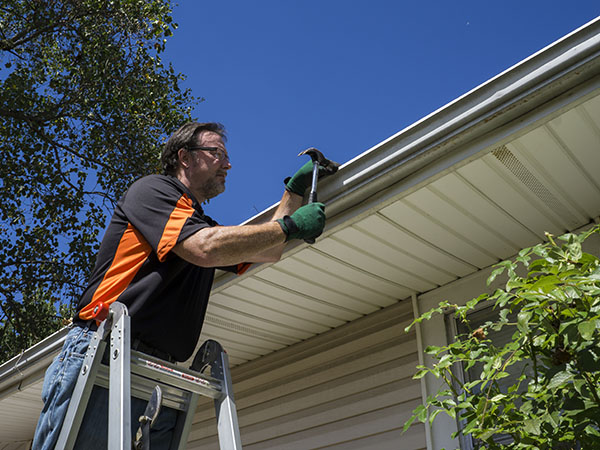
Gutters help protect a Canton, GA home by directing roof runoff away from siding, landscaping, and the foundation. When a system starts leaking, sagging, or overflowing, homeowners should first determine whether the problem is debris, a localized defect, or broader system deterioration. Rise Residential Roofing provides residential gutter services in Canton and can be reached at (678) 772-6995.
Gutter Replacement in Canton, GA: Repair vs Replace
A replacement decision should follow the condition of the full gutter system rather than one visible symptom. A leaking joint may be repairable when the surrounding sections, supports, fascia, outlets, and downspouts remain serviceable. Repeated failures across several sections, widespread sagging, damaged supporting material, or a system that cannot manage runoff effectively may justify comparing replacement with continued repair.
Cleaning, repair, and replacement solve different problems. Debris removal restores flow when the system is otherwise sound. A localized repair addresses a defined defect. Full replacement is a broader project that should be supported by evidence that the existing system is no longer a practical repair candidate.
Cleaning, Repair, or Replacement?
- Cleaning or maintenance: Appropriate when leaves, roof grit, or other debris are restricting flow but the gutter channel, supports, outlets, and downspouts remain in usable condition.
- Localized repair: Appropriate when the defect is limited, such as an isolated leaking joint, loose support, damaged section, or correctable alignment issue.
- Replacement: Worth evaluating when deterioration is repeated or widespread, support conditions are compromised in multiple areas, or repairs are no longer restoring reliable drainage.
For homeowners comparing a repair with replacement, Rise’s gutter repair guidance for Canton provides additional context on isolated leaks, loose fasteners, sagging, and downspout restrictions.
Drainage and Scope Checklist
Before choosing a scope, the inspection should follow the full drainage path from the roof edge to the discharge point. The checklist below helps separate a limited repair from conditions that may require a larger project.
| What Gets Checked | What the Finding Helps Determine |
|---|---|
| Joints and seams | Whether leakage is isolated or repeated across multiple connections. |
| Supports and fasteners | Whether the gutter can be realigned and secured or whether attachment failure is broader. |
| Downspouts and outlets | Whether overflow involves a restriction, outlet placement, or a capacity concern that needs further evaluation. |
| Fascia and supporting material | Whether the surface behind the gutter remains suitable for repair or needs separate corrective work. |
| Discharge routing | Where water is released and whether the final route keeps runoff away from areas that should remain dry. |
| Maintenance access | How future inspection and debris removal can be handled without overlooking hard-to-reach sections. |
Signs That May Change the Gutter Replacement Scope
Sagging gutters. Sagging can come from loose fasteners, accumulated weight, damaged supports, or alignment problems. A limited section may be repairable, while movement across several runs calls for a broader assessment.
Separated seams and repeated leaks. One leaking joint does not automatically require replacement. Repeated separation at several points, especially when combined with movement or deteriorated sections, gives the homeowner more reason to compare replacement with continued repairs.
Pitch and drainage problems. Water should move toward the outlets rather than remain in low spots. Some alignment problems can be corrected, but recurring ponding or overflow should prompt a review of slope, outlet locations, downspouts, and overall sizing before the next scope is approved.
Fascia or supporting damage. If moisture has affected the material behind the gutter, the repair plan should address that condition instead of simply fastening a new gutter to a compromised surface.
Professional Sizing and Closeout Checks
A replacement should not automatically copy the size or downspout layout of the old system. Roof area, roof geometry, runoff concentration, gutter dimensions, outlet locations, and downspout arrangement all influence drainage performance. Rise also explains these installation considerations in its Canton gutter installation guide.
After installation or repair, closeout should confirm that the agreed work was completed and that water can move through the system as intended. Useful checks may include reviewing slope toward outlets, sealed connections, secure supports, downspout flow, cleanup, and any conditions that still require monitoring. A flow check can support closeout when appropriate, but it should not be treated as a guarantee against every future overflow condition.
When Seamless Gutters Are Part of the Replacement Plan
Seamless gutters use longer continuous runs with fewer field joints than traditional sectional systems. Fewer joints can reduce the number of potential leak locations, but the system still depends on proper sizing, attachment, outlet placement, downspouts, and maintenance. The choice should be based on the home and project scope rather than an assumption that one gutter type is always better.
Gutters also work as part of the home’s broader roof-drainage system. Rise’s shingle roofing information provides additional context on the roof surface that sheds water into the gutter system.
Gutter Replacement in Canton, GA
For a Canton homeowner, the best replacement decision starts with evidence: identify the actual defect, determine whether it is isolated or repeated, inspect the supports and fascia, review downspouts and discharge routing, and confirm whether the existing system can still be repaired effectively.
Rise Residential Roofing installs residential gutter systems in Canton, GA. Call (678) 772-6995 to schedule an evaluation and discuss whether maintenance, localized repair, or replacement fits the condition of your gutters.
Frequently Asked Questions
Can gutters be repaired instead of replaced?
Yes. Localized leaks, loose fasteners, or isolated alignment problems may be repairable when the surrounding system remains serviceable.
What makes full gutter replacement worth considering?
Replacement is worth comparing when deterioration is repeated across multiple sections, support conditions are broadly compromised, or repairs are no longer restoring dependable drainage.
How should replacement gutters be sized?
Sizing should account for the roof area, roof geometry, runoff concentration, gutter dimensions, outlets, and downspout arrangement rather than simply copying the old system.
What should be checked after gutter work is finished?
Closeout should confirm the agreed work, alignment toward outlets, secure supports, sealed connections, downspout flow, cleanup, and any remaining conditions that need monitoring.